
Systems Thinking in Practice: Masterclass for Transformational Adaptation in Wales: Event Summary and Reflections

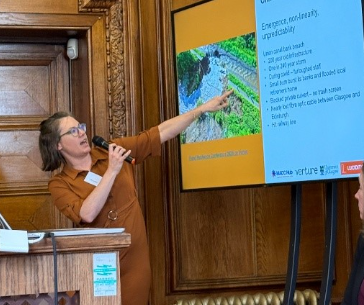
This is a post-event reflection from the MACC Hub Systems Thinking in Practice Masterclass for Wales held at Cardiff on March 3 for public sector organisations and individuals. For more details, please contact the author.
Introduction
On the 3rd March, practitioners supporting Public Service Boards from multiple public sector organisations across Wales came together in Cardiff for a MACC Hub masterclass on Systems Thinking in Practice. Led by Professor Jaime Toney (University of Glasgow), Dr Elaine Heslop (Lucidity) and Mary Collacott (Verture) and hosted by Camilla Curry at Severn Estuary Partnership, the session explored how systems thinking can support more effective and transformational climate adaptation.
The workshop focused on helping practitioners move beyond linear approaches to planning, and instead understand the wider systems shaping climate risks and responses.
Why systems thinking?
The session began with inviting participants to reflect on what systems thinking means in the context of climate adaptation planning. An interactive icebreaker quickly highlighted the importance of applying systems thinking to climate adaptation challenges, with the need for approaches and tools that recognise how challenges are interconnected, operate across different scales, and change over time.
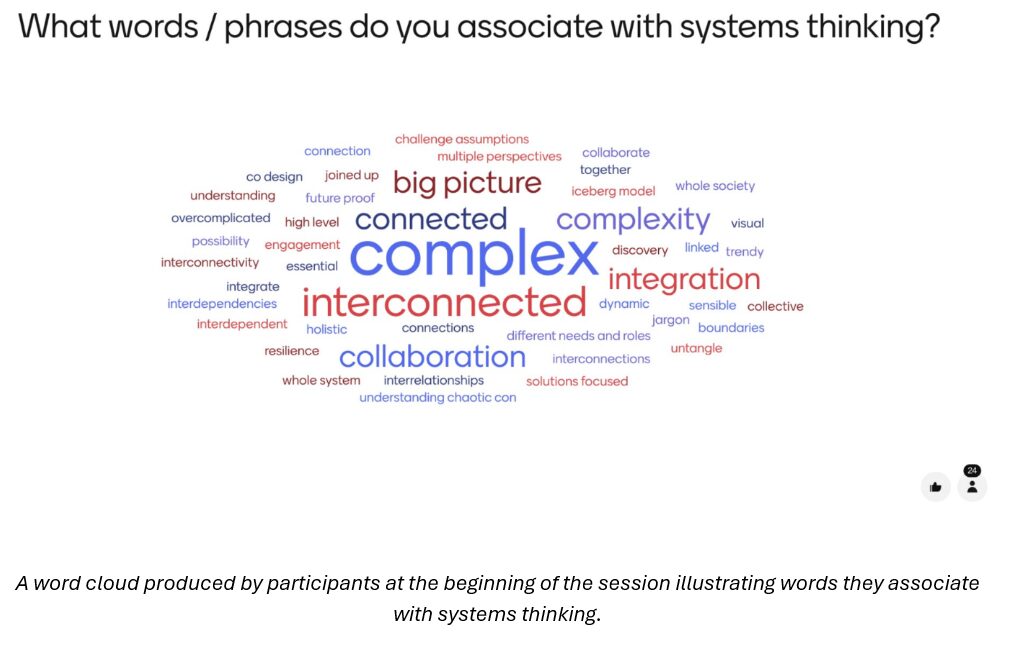
The MACC Hub team introduced some of the key features associated with complex systems, drawing on work by the Centre for the Evaluation of Complexity Across the Nexus (CECAN), including:
- Emergence, non-linearity and unpredictability
- Adaptation and path dependency
- Multiple scales and levels
These concepts were grounded in climate adaptation examples, including:
- System-wide implications of heat on health and wellbeing explored through the Clyde Rebuilt – Climate Ready Clyde project
- Opportunities to embed climate resilience in spatial planning through the Glasgow City Region Adaptation Strategy
- Glasgow’s tidal flood risk challenges and solutions that highlighted working across different levels of governance linked to Scottish Government’s National Planning Framework 4[1].
Exploring systems thinking in practice
Participants learned how systems thinking tools can be used in practice to support climate adaptation planning and delivery. Key tools explored included:
Participatory Mapping and Rich Pictures
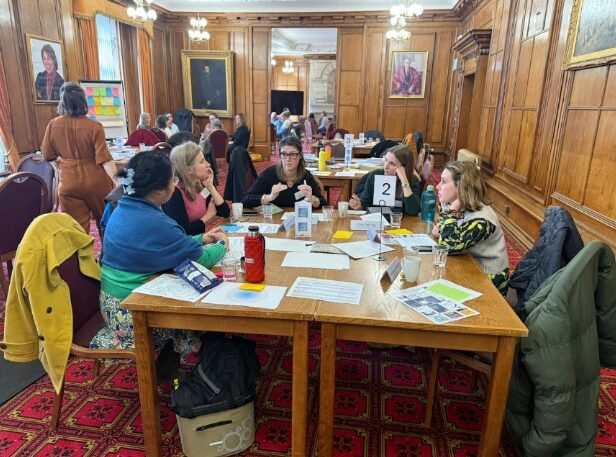
Participants created ‘rich pictures’ to visually represent the systems they work within, helping to highlight connections, complexity and gaps. This exercise supported shared understanding and helped identify potential leverage points for change.
Climate adaptation case studies showcased included participatory mapping undertaken for the Carbon Neutral Islands project.
System Maps and Causal Loop Diagrams
Jaime, Elaine and Mary presented a variety of visual tools to help practitioners move beyond lists of risks to understand feedbacks, cascades, co‑benefits and maladaptation potential.
They also outlined how mapping exercises can help to draw out the potential interactions between a range of sector actors to identify opportunities and complexities within a system and where actors will need to be more aligned to deliver goals. Example case studies included a stakeholder mapping exercise developed as part of the Glasgow City Region Adaptation Strategy.
Challenge Lab sessions
In the afternoon, participants engaged in a facilitated Challenge Lab, following Chatham House rules. In these sessions:
- One person presented a real‑world systems challenge they faced.
- Peers explored the challenge through structured curiosity and questioning.
- The group worked collectively to identify overlooked dimensions, offer fresh perspectives and new connections.
- Presenters reflected on insights and actions they intended to take forward.
These labs proved to be a powerful way of applying systems thinking tools to Wales‑specific climate adaptation challenges, revealing new opportunities that emerge through collaborative sense‑making and the value of bringing the cross‑sector adaptation community together – many of whom are facing similar challenges but have not previously had the chance to connect.
Insights from the day
Several key themes emerged throughout the day:
- Systems thinking allows practitioners to see risks, opportunities and connections that may be missed using more linear approaches.
- Involving different perspectives leads build richer and more grounded system understanding whilst building trust between stakeholders.
- System tools work best when treated as living documents that evolve over time with new insights, placing value on the process as much as the outcome.
Participants feedback
“Thank you. Really helpful, practical with lots of ideas, tools and case studies to try and to follow up.”
“[the session highlighted] the importance of climate and nature practitioners getting into other disciplines and spaces to translate our work to other people’s realities and priorities”
“Feeling inspired & energised!”
Looking ahead
This masterclass encouraged participants to embed systems thinking more deeply into their climate adaptation planning and practice, while also making new connections and identifying shared challenges and opportunities in the climate adaptation space in Wales.
The MACC Hub encourages practitioners to continue experimenting, learning and sharing as they navigate the complexities of delivering climate adaptation in their own contexts.
A huge thank you to everyone who brought their energy, experience and curiosity to the session, and to Elaine, Jaime and Mary for guiding such a rich and insightful masterclass.
Further reading
[1] Prasojo et al. (2025) Right size, right place: scale-dependency of managed realignment to mitigate flood hazards in urban estuaries. Environmental Research Letters, 20(7), 074069.
Further resources


Transformational Adaptation: An Introduction

Glasgow City Region Climate Adaptation Strategy and Action Plan



Comments
There is no contentYou must be logged in to reply.