
Paludiculture in the UK: Will this new form of farming help peatlands and people?

This blog has been written specifically for the MACC Hub website. Views and opinions expressed in blog posts are those of the individual authors and do not necessarily reflect the views of the organisation or its partners. Blog content is provided for general information purposes only and should not be taken as professional or legal advice. While we aim to ensure accuracy, we make no representations or warranties regarding the completeness, reliability or suitability of the information presented.
Peatland Context in the UK
In recent decades, peatlands have garnered global attention due to their potential to both mitigate climate change or exacerbate it. In their untouched state, peatlands are significant storers of carbon, storing twice as much carbon as all the world’s forests. However, centuries of peatland drainage for infrastructure, agriculture, horticulture, forestry, and energy, has resulted in their degradation and release of carbon emissions. In the UK, 90% of its lowland peatlands are drained for agriculture which amounted to 3% of the entire nations’ greenhouse gas emissions in 2017. This is because lowland agricultural drained peat has a much higher carbon emission factor compared to most other lowland peatland uses.
Until largely the last five years any move towards more sustainable lowland peatland management practices was at a standstill because of the lucrative agri-businesses attached to lowland peatland farming. Around 40% of vegetables grown in the UK are produced on lowland peat soils. Additionally, whilst the upland peatland restoration industry had kicked off in the early 2000s, there was significantly less research on lowland peatland restoration and management solutions. Consequently, landowners and land managers had limited access to sustainable lowland peatland management options that could incentivize a shift away from drainage on peat soils.
To address this standstill, the UK government-initiated research efforts – such as the Lowland Peat 2 Project – to investigate sustainable management approaches that could offer practical and financially viable alternatives. Emerging from this research was one particular management practice policymakers and researchers considered a win-win-win solution: paludiculture.
What is Paludiculture
Paludiculture is the practice of farming in wet or rewetted peatlands. The concept was defined by German researchers in the late 1990s. There are countless crops that can be grown via paludiculture in the UK including blueberries, Sphagnum moss, Typha, and willow. It is viewed as a win-win-win solution because it preserves peat soil, reduces carbon emissions, and theoretically provides landowners and managers with an income.

A paludiculture crop of reeds in the Broads National Park. Photo credit: Author
There has been a notable recent increase in funding in the UK towards paludiculture research and innovation. For example, in 2023 the Department for Environment Food and Rural Affairs supported 12 projects via the £5 million Paludiculture Exploration Fund and in 2024 the Co-op Foundation’s £3.5 million Carbon Innovation Fund supported projects investigating ways to grow food on peatlands without damaging them.
There are currently over 15 registered paludiculture projects on the paludiculture.org.uk website with many more happening on the ground in peatland geographies across the UK, including East Anglia, Lancashire, Cumbria, Somerset, and Shropshire. Some paludiculture trials have been occurring for more than three years, gaining crucial results and experiences to enhance the novel farming practice. For example, one of the trials is delivered in partnership between the Lancashire Wildlife Trust, a tenant farmer, the landowners, and Ponda. In June 2024 bulrush seeds were sown on a rewetted lowland peatland site. More than a year later, the bulrush was sucessfully harvested in August 2025 using a specialised digger.
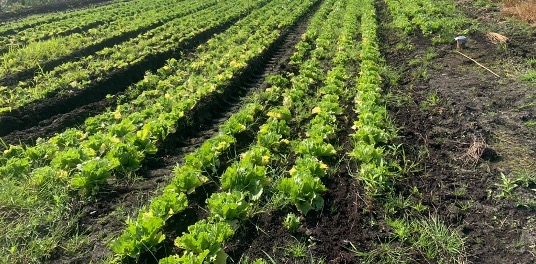
In East Anglia, Fenland SOIL, a non-profit tackling climate issues relating to agriclture and peatlands in the Fens, has been growing celery, Chinese leaf, miscanthus, and lettuce on their paludiculture trial which was set up in 2024. In 2025 the crops were sucessfully harvested by hand, though yields were reduced compared to conventional farming on drained peat soils.
Barriers
Paludiculture is still an extremely new sustainable peatland management practice and faces a number of barriers to its adoption. Notably, more research on the hydrology, ecology, and agronomy of paludiculture is required. In particular, there are still questions about optimal harvesting time, harvesting machinery, and fertilizer use.
Whilst paludiculture can enable landowners and land managers to make money from sustainable peat management this relies on strong market systems or policy incentives. Currently landowners and managers can get paid for peatland restoration and rewetting, including paludiculture, through the Environmental Land Management Schemes in the UK. However, these incentives are subject to change and are, in many cases, not sufficient for landowners and land managers to make the switch to paludiculture.
Some paludiculture markets do exist. For example, Ponda, a bio-materials company founded in 2020, uses the fibers from the fluffy head of Typha latifolia (bulrush) to create the insulation in puffer jackets and other garments.

One of Ponda’s garments, made with Typha latifolia. Photo credit: https://shop.ponda.bio/products/biopuff®-jacket-by-ponda-1
Though, many of the potential paludiculture markets for food, medicinal treatments, construction productions, or horticulture face regulatory barriers, competition from non-paludiculture systems, lack the processing and manufacture infrastructure, and market visibility. Crucially, strong policy incentives and/or reliable paludiculture markets are important to increase landowners and managers’ adoption of this new farming practice so they can continue to earn a living from their land.
Another key challenge lies in fostering a cultural shift among landowners, land managers, and local communities towards embracing wetter landscapes. Many farmers in the UK remember when their parents, grandparents, or great-grandparents were incentivised to drain their land after World War II. This has led to an innate understanding that dryer land is the norm, better and more productive. Moreover, the shift towards wetter farming is dependent on people learning new methods and skills, such as water table management, paludiculture crop agronomy, and understanding new markets.
Opportunities
Despite these barriers it is critical to recognise that paludiculture has only been practiced in the UK for the past 5 – 8 years. Thus, the amount of research and progress that has already been made is immense. Opportunities exist in understanding how paludiculture can be implemented in landowner and managers’ fields which may become increasingly hard-to-farm due to more extreme weather from climate change.
Paludiculture is being offered by peatland practitioners and land advisors as a resilient farming system, which can replace hard-to-farm land (crucially not the entire farm), and offer other co-benefits such as flood mitigation and the slowing down of land subsidence.
With greater visibility and the continuation of trials and research, paludiculture has the opportunity to benefit the farming community, private businesses, and local communities. Paludiculture can be connected to wider agendas such as reducing farm’s carbon emissions for supermarket standards, increasing on-farm climate resilience, providing sustainable products, and increasing investment towards local climate adaptation solutions.
Relevant Transformational Adaptation Pillar(s)
Systems Thinking: is about looking at the bigger picture – how different sectors, places, and people are connected – and making sure actions in one area don’t cause problems in another. It means working across boundaries, creating benefits for people and nature, and being fair about who carries the costs.
The project takes a whole-systems view of peatlands, recognising the interconnections between climate mitigation, agriculture, land use, hydrology, biodiversity, rural livelihoods and markets. Paludiculture is framed as a “win-win-win” solution that addresses carbon emissions, ecological degradation and farm income simultaneously, while also delivering co-benefits such as flood mitigation and reduced land subsidence. It explicitly moves beyond single-sector solutions by linking farming practices, climate policy, research, industry and supply chains.
Changes to governance, values and approaches: Adaptation means rethinking how decisions are made and resources are shared. This pillar calls for new ways of governing, fairer distribution of costs and benefits, and securing long-term funding, skills, and capacity.
A core theme is the need to move beyond business-as-usual land management and policy frameworks that historically incentivized peat drainage. The text highlights reliance on policy incentives (e.g. Environmental Land Management Schemes), regulatory barriers, market gaps and the need for long-term, stable governance and funding to support transition. It also emphasizes a cultural and values shift among landowners and communities – from seeing dry land as “better” to accepting wetter, adaptive landscapes – alongside new skills, knowledge and business models.
This blog draws on PhD research, and a further blog can be found on The Conversation news site.
Further resources



MACC PROJECT: Joined Up Landscapes

Comments
There is no contentYou must be logged in to reply.