
King’s College London convenes climate adaptation community to help shape future UK policy


This write up is reproduced in its entirety from a News Centre item on King’s College London’s website. The MACC Hub was an organiser of the event.

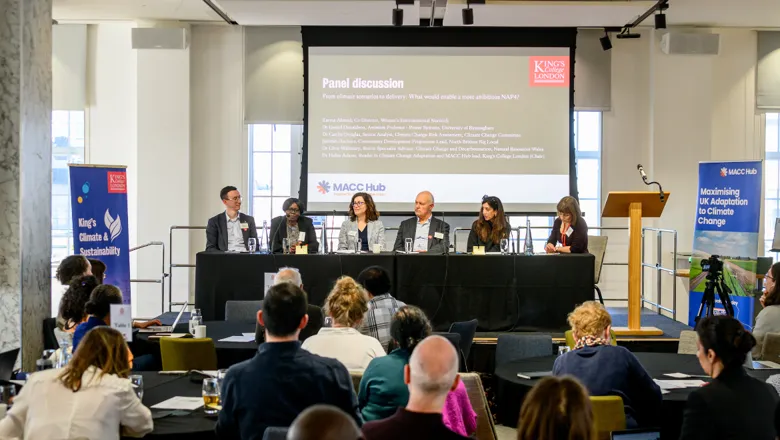
Jointly organised by the Maximising UK Adaptation to Climate Change (MACC) Hub and King’s Climate & Sustainability, the event sought to share evidence and insights to strengthen the UK’s approach to climate adaptation.
The UK’s National Adaptation Programme (NAP) sets out the actions that the government and partners will take to adapt to climate change. NAP3 covers 2023-2028, and this event was part of a programme of knowledge exchange to support the framing of NAP4.
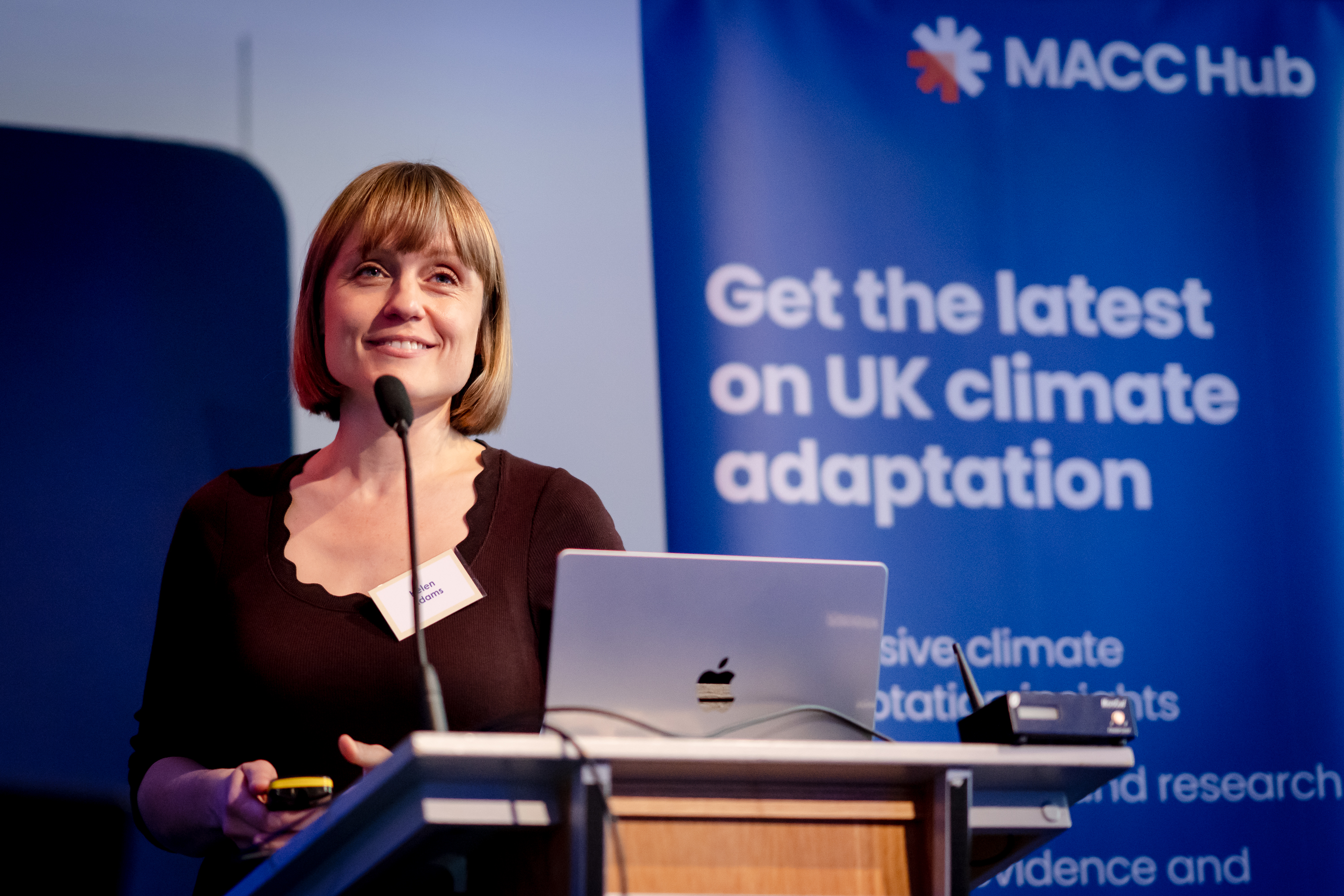
The event featured an introduction from Dr Helen Adams, Reader in Climate Change Adaptation at King’s and MACC Hub lead, who explained why climate adaptation requires transformational approaches that centre equity and address vulnerability.
“We’re trying to improve how we talk about adaptation – moving from dystopian futures to hopeful futures – and making sure that equity and justice are at the heart of what we do. Transformational adaptation is about understanding the complex systems that lead to vulnerability, thinking across sectors and ensuring that what we do on the ground truly addresses structural barriers.“
Dr Helen Adams, Reader in Climate Change Adaptation at King’s and MACC Hub lead

Natalie Roberts, Natural Environment Adaptation Policy Team Lead at the Department for Environment, Food and Rural Affairs outlined how the department is coordinating the UK’s National Adaptation Programme.
Roberts explained how the next Climate Change Risk Assessment, due in 2027, will feed into NAP4, creating a benchmark for departments to prepare for at least a two-degree warming scenario. The goal is to provide a framework that enables ambitious and measurable adaptation across all sectors, while allowing departments the flexibility to go further.
A panel discussion focused on moving from climate scenarios to delivery, seeking a range of perspectives on ‘What would enable a more ambitious NAP4?’ Panelists joined from the Climate Change Committee, Natural Resources Wales, North Brixton Big Local, University of Birmingham and Women’s Environmental Network, sharing a range of perspectives on strengthening adaptation.
“We were delighted to welcome colleagues from government, universities, business and civil society to King’s to contribute to an important national policy discussion on climate adaptation. Achieving climate resilience will need to be transformational and collaborative, and events like these help provide ideas, expertise and insights to strengthen policy and practice in all four UK nations.“
Professor Frans Berkhout, Assistant Principal (King’s Climate & Sustainability)

King’s has a community of researchers with expertise in advancing climate adaptation and resilience in the UK and internationally, and part of the event showcased research projects led by or involving King’s academics. Poster topics included:
- CLARITY-Africa, a project which aims to strengthen the climate change resilience of cities across Africa – presented by Dr Shona Macleod, Department of Geography
- Effects of temperature on mental health in vulnerable urban communities – presented by Professor Ioannis Bakolis, Institute of Psychiatry, Psychology & Neuroscience
- Empowering resilience in a sinking city, a project focusing on urban floods in Jakarta, Indonesia – presented by Dr Zara Shabrina and Dr Jin Rui, Department of Geography
- Hopeful Futures, a collaborative project with Londoners to imagine what a well-adapted London could look like – presented by Dr Kirstie Hewlett, The Policy Institute and Dr George Adamson, Department of Geography
- Improving climate adaptation communication for the elderly with local charity Age UK Lambeth – presented by Dr Fatima Wang, King’s Business School
- Leverhulme Centre for Wildfires, Environment and Society projects at King’s that focus on wildfire adaptation and resilience – presented by Abdullah Rehman, Department of Engineering
- REVIVE: Regaining the liveability of place: emancipatory futures under climate risk– presented by Dr Helen Adams, Department of Geography
Further resources
MACC Hub Annual Conference 2025: highlights, insights and next steps


MACC Hub: Awarded Projects

MACC PROJECT: Adapting to climate-induced food price shocks in the UK

Comments
There is no contentYou must be logged in to reply.