Wales
This is a vibrant community of practice where local leaders, researchers, businesses, and residents share ideas, tools, and stories to make Wales climate-ready. Join us to swap resources, ask questions, and co-create a fair, thriving future for every corner of Wales.
Ocean Literacy Strategy for Wales 2025
The Ocean Literacy Strategy Wales sets out a collaborative, long-term approach to strengthening people’s connection with the sea, supporting informed action, resilient marine ecosystems and community wellbeing across Wales.

MACC Hub Webinar Series #6: The role of policy and private capital in transformational adaptation
Join our webinar “The Role of Policy and Private Capital in Transformational Adaptation” to explore how public policy and private finance can work together to deliver long-term, inclusive adaptation, the trade-offs and risks involved, and what meaningful alignment looks like in practice.


MACC Hub: Awarded Projects
The MACC Hub supports place-based climate adaptation projects across the UK. Ten projects have now been awarded funding to address local climate risks and deliver practical, scalable solutions.

Survey: Training needs for Transformational Climate Adaptation
Climate change is reshaping daily life, yet adaptation often remains incremental and technocratic. This piece explores why transformational approaches are needed, what capabilities they demand, and invites professionals to complete a survey that will guide new training approaches to address systemic vulnerability.
Three Horizons Toolkit
The Three Horizons Toolkit has been developed by Public Health Wales and the Future Generations Commissioner’s Office to help public bodies avoid making decisions that don’t stand the test of time. It is based on a model developed by Bill Sharpe and the International Futures Forum.
The Halfway Mark for Adaptation at COP30
Saturday 14 November marked the halfway point of COP30; a moment for negotiators to step out of closed rooms and take stock as the Subsidiary Bodies wrapped up their work. The state of play for adaptation? Rocky at best.


Inform the next Climate Change Risk Assessment Independent Assessment (CCRA4-IA) Technical Report
This call for review with a 2 December deadline is reproduced from the original notice on the Met Office website....

Re-thinking people and nature interactions in urban Nature-Based Solutions
People-environment interactions within nature-based solutions (NBS) are not well understood. As an asset NBS includes both natural capital and human-centred capital. NBS also exist as a system with which people can interact.
.
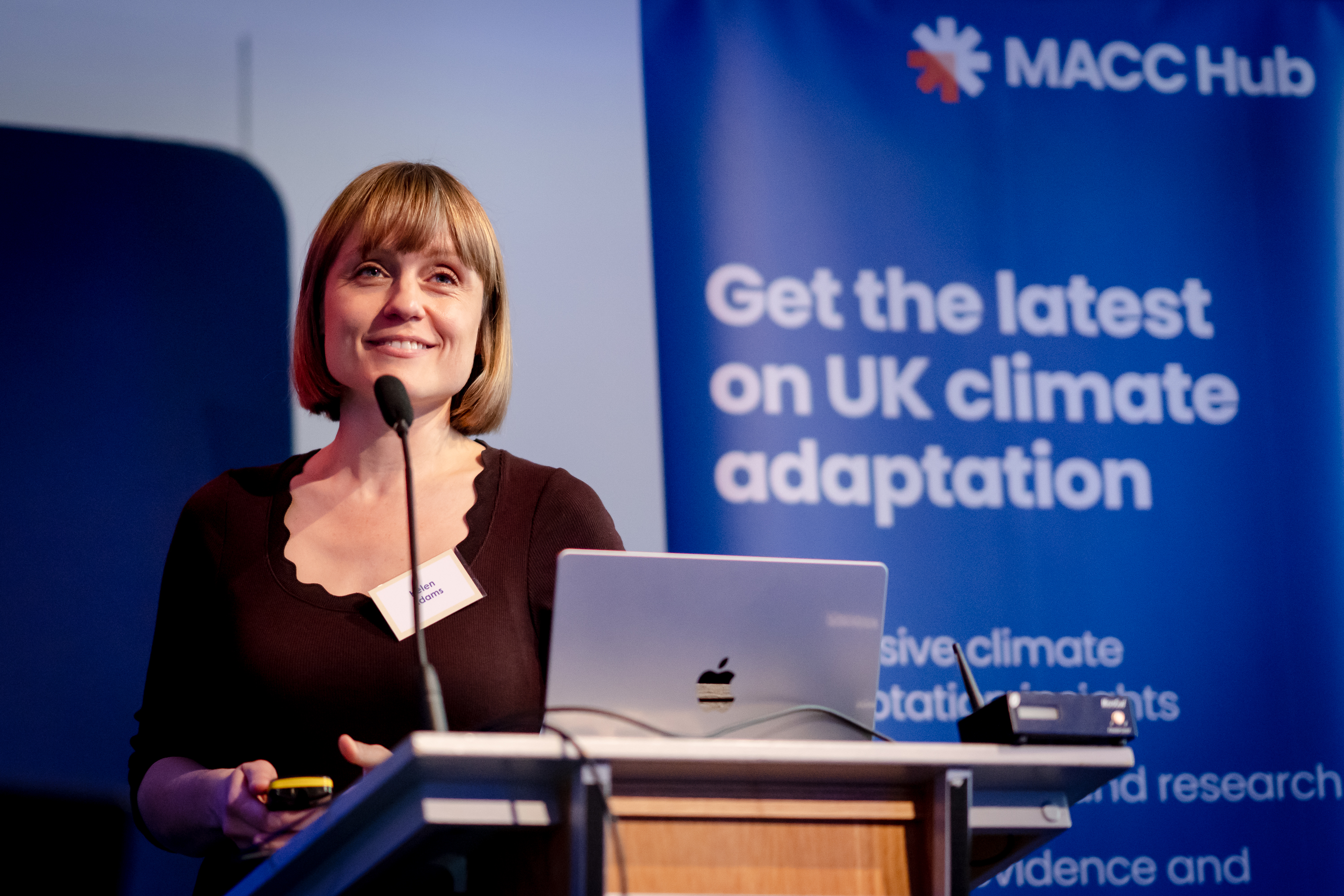
MACC Hub Annual Conference 2025: highlights, insights and next steps
On September 25, we reached an exciting milestone: the first-ever MACC Hub Conference, hosted by Verture, part of the Hub's Scotland Spoke. Over 200 people from across research, policy, and practice came together to share ideas, spark collaboration and turn climate adaptation from theory into real, practical action. Here’s a look back at the day: the highlights, the insights and where we’re heading next.
European Citizen Science Association 2026 Conference
ECSA 2026 will be held in Oulu, Finland, 2-7 March, 2026. It will be hosted by the University of Oulu in a year when the city holds the title of the European Capital of Culture.