
Adapting to climate change: Progress in England



This article is a summary version of the original text, which can be downloaded from the right-hand column. Please access the original text for more detail, research purposes, full references, or to quote text. It has been reproduced under Climate Change Committee copyright 2025.
Summary
This 2025 report to Parliament from the UK Climate Change Committee (CCC) is the first statutory assessment of the UK’s Third National Adaptation Programme (NAP3). The overarching conclusion is stark: the UK’s preparations for climate change remain inadequate. Echoing the conclusions of the 2023 report, the Committee finds that the delivery of effective adaptation has stalled, planning continues to be piecemeal and disjointed, and NAP3 has been ineffective in driving the urgently needed shift from planning to action. While this is a UK-wide assessment, NAP3 primarily covers devolved policy areas for England, making these findings particularly relevant for England’s progress.

Figure 1: Overall summary of progress in preparing for climate change (Source: CCC, 2025). The bars show the percentage of required outcomes for both “Policies and plans” (top bar for each sector) and “Delivery and implementation” (bottom bar). The overwhelming lack of green (“Good”) visually confirms the report’s findings of inadequate progress.
Key Messages
The key messages as outlined by the Climate Change Committee are as follows:
- The UK’s preparations for climate change are inadequate. Delivery of effective adaptation remains limited, and planning continues to be piecemeal and disjointed. The vast majority of assessment outcomes have the same low scores as in 2023.
- Adaptation progress is either too slow, has stalled, or is heading in the wrong direction. In terms of adaptation delivery, the CCC did not find evidence to score a single outcome as ‘good’. It is clear that NAP3 has been ineffective in driving the critical shift towards effective delivery of adaptation.
- The Government must act without further delay to improve the national approach to climate resilience. A new approach is still possible, and the report recommends four key areas of action to raise the profile of adaptation across government and drive a more effective response to the UK’s changing climate.
Adaptation Areas
This report assesses progress across thirteen thematic areas, which are explored in detail within the main assessment chapters:
- Nature (Chapter 2.2.1, p.49)
- Working land and seas (Chapter 2.2.1, p.49)
- Food security (Chapter 2.2.1, p.51)
- Water supply (Chapter 2.2.2, p.55)
- Energy (Chapter 2.2.2, p.59)
- Telecoms & ICT (Chapter 2.2.2, p.61)
- Transport (Chapter 2.2.2, p.63)
- Towns and cities (Chapter 2.2.3, p.67)
- Buildings (Chapter 2.2.3, p.74)
- Community preparedness and response (Chapter 2.2.3, p.77)
- Health (Chapter 2.2.4, p.80)
- Business (Chapter 2.2.5, p.83)
- Finance (Chapter 2.2.5, p.86)
Outcomes and Impacts: Three priority areas for England
The impacts of England’s adaptation shortfalls are evident across the country. The CCC’s findings can be illustrated by examining three priority areas that highlight different types of failure in the national adaptation effort:
1. A sector with plans, but worrying progress: The Natural Environment (Nature – Chapter 2.2.1, p.49)
This category represents a failure in delivery despite having multiple high-level plans. The Natural Environment is a prime example. England has foundational strategies like the Environmental Improvement Plan, but the report shows that the health of crucial ecosystems is declining.
A stark statistic highlights this delivery gap: for freshwater habitats, the government’s target is to have 75% of water bodies in good ecological status. However, the most recent data shows only 16% have achieved this target. This indicates that even with established plans, the actions taken are insufficient to halt environmental decline. To address this, the report recommends that the Government integrates its approach to climate adaptation across all of Defra’s forthcoming foundational strategies, including the Environmental Improvement Plan and Land-Use Framework.
2. A sector with actions, but overwhelming risk: Flood Defence (Towns and cities – Chapter 2.2.3, p.67)
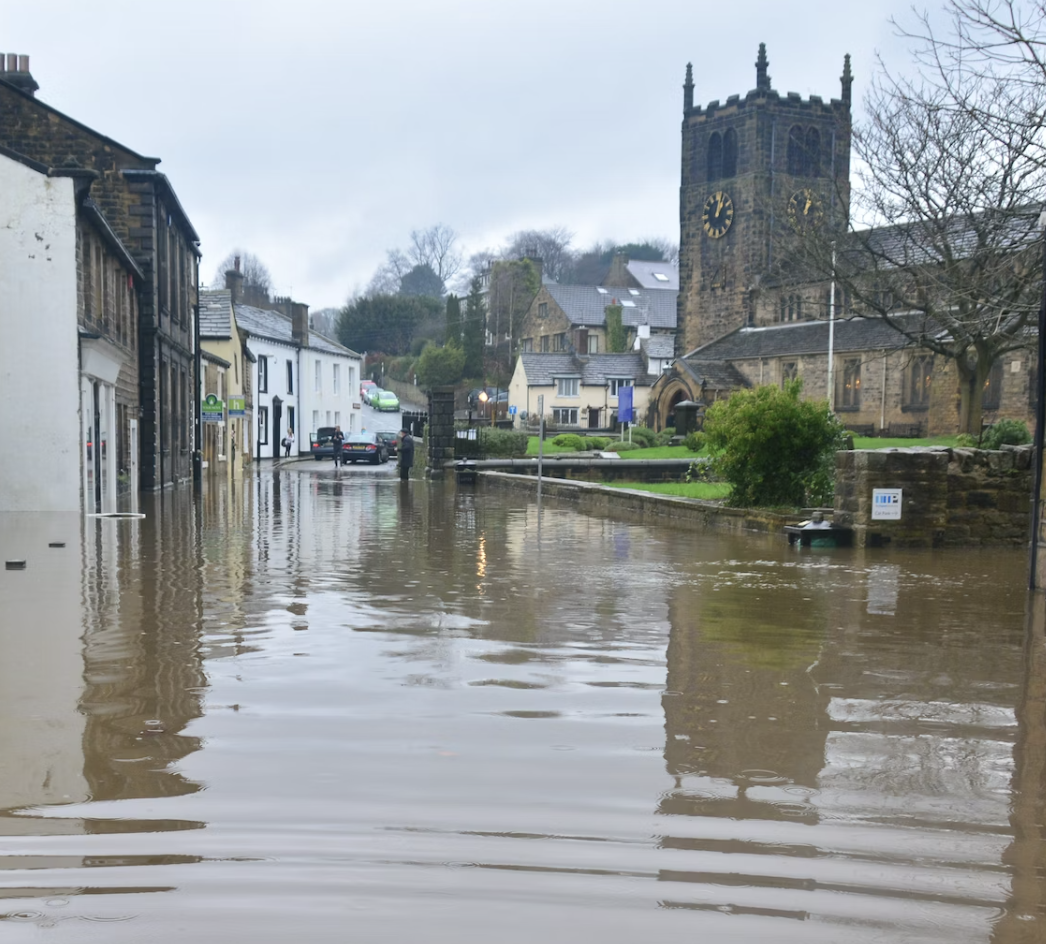
This category represents a failure to match the scale of action to the scale of the risk. Flood and Coastal Risk Management fits this perfectly. The government has a significant £5.2 billion investment programme running from 2021 to 2027 to protect homes.
However, these actions are being outpaced by escalating risks and delivery challenges. The programme’s target has already been reduced by 40%, from protecting 336,000 homes to only 200,000. More alarmingly, the physical condition of existing flood defence assets is declining. An analysis by the National Audit Office found that due to assets being below their required condition, 203,000 properties are now at an increased risk of flooding. Therefore, the report recommends that the Government includes long-term targets on the net change in flood risk in the next investment programme, supported by sufficient funding and a clear delivery plan.
3. A systemically neglected sector: Urban Heat Risk (Towns and cities – Chapter 2.2.3, p.67)
This category represents a failure in the scope and vision of the national programme, where a critical risk is systematically overlooked. The management of Urban Heat Risk is a clear example of this neglect.
Heat-related deaths are already rising, potentially exceeding 10,000 per year by 2050. Despite this, the CCC report states unequivocally that “there is no overarching strategy for adapting to and managing future urban heat risks across government”. Progress on this critical issue was scored as “Unable to evaluate” precisely because there are no national datasets that record the implementation of adaptation measures like urban greening. This highlights a major policy gap and a lack of coordinated, strategic action for a rapidly growing threat.
Assessment Findings
Consistent with previous assessments, this report finds that no sectors are yet well adapted to the risks of climate change. While some consideration of climate change within plans is becoming more prevalent, evidence of tangible progress in reducing exposure and vulnerability is lacking across the board.
- Delivery and Implementation: For no outcome has the Committee been able to conclude that there is sufficient evidence of progress at the rates needed to manage risk. The vast majority of outcomes received the same low score as in 2023, with a small number of improved scores coming from new evidence via the Adaptation Reporting Power (ARP). Conversely, some scores, such as for water system performance, have worsened because the observed rate of leakage reduction is clearly inconsistent with the sector’s target.
- Policies and Plans: Credible planning for climate change is only found for three out of the 45 adaptation outcomes examined. Progress remains slow, and NAP3 has struggled to make adaptation a key priority for policy development in many government departments. While 11 policy scores have improved since 2023, four others have worsened as plans are no longer aligned with their stated objectives, including in areas like water demand and protection from river and coastal flooding.
- Data Gaps: For nearly 40% of adaptation outcomes, the lack of relevant and up-to-date indicator datasets prevents a judgement on progress. This long-standing issue remains a critical barrier to effective progress monitoring.
Lessons Learned
The report’s persistent findings over multiple assessment cycles offer clear lessons for the future of adaptation policy:
- Planning without delivery is ineffective: The slow progress under three successive National Adaptation Programmes demonstrates that simply having a plan is not enough. A relentless focus on delivery, implementation, and action is critical.
- Adaptation must be a cross-government priority: A piecemeal approach coordinated by a single department is insufficient. To be effective, climate resilience must be integrated into all government activities, spending decisions, and departmental objectives.
- Effective monitoring is the bedrock of progress: It is impossible to manage what is not measured. Closing the long-standing gaps in monitoring, evaluation, and data collection is an essential prerequisite for effective adaptation.
- A successful programme needs clear, measurable targets: A clear vision for a well-adapted country, underpinned by specific and measurable targets, is a vital first step to provide an actionable framework for government, the private sector, and households.
Recommendations: Four Key Actions to Reshape the National Approach
To address the profound shortfalls, the CCC concludes that a refreshed cross-government approach is urgently needed. The report puts forward four key programme-level recommendations to prepare the ground for a much stronger national plan.
- Implement monitoring, evaluation, and learning: The long-standing gap of an effective monitoring and evaluation framework must finally be closed. Government should coordinate relevant agencies to collect the key indicators needed to track the delivery of adaptation and the evolution of climate risks, focusing on areas where evidence is currently poor.
- Improve objectives and targets: This requires creating a clear vision for a well-adapted UK, underpinned by a set of specific and measurable sectoral targets. It is vital to provide an actionable framework and to clearly communicate the respective roles of government, the private sector, and households in delivering and funding adaptation.
- Improve coordination across government: Adaptation and climate risks are still only weakly integrated with wider government efforts. Greater coordination is required across activities, spending decisions, and departments. This includes better integration with resilience activities like the National Risk Register and using standardised extreme weather scenarios for stress-testing.
- Integrate adaptation into all relevant policies: The next Spending Review is a vital opportunity to ensure that climate resilience is supported with sufficient resources across government and that spending is not locking in additional, costly climate risk.
Sectoral Priorities
The report also provides detailed sectoral recommendations, urging the government to integrate climate resilience into forthcoming strategies for land use, infrastructure, water regulation, urban planning, public health, and finance.
Suggested Citation
Climate Change Committee (2025) Progress in adapting to climate change, 2025 report to Parliament. Available at: https://www.theccc.org.uk/publication/progress-in-reducing-emissions-2025-report-to-parliament/ (Accessed: 5 August 2025).
Further resources

Adapting to climate change: Progress in Northern Ireland

Adapting to climate change: Progress in Wales


CCC: England’s approach to climate adaptation is ‘not working’
Comments
There is no contentYou must be logged in to reply.