
Deliberative approaches to the climate crisis: Adapting Climathons for rural communities

This article is an abridged version of the original text, which can be downloaded from the right-hand column. Please access the original text for more detail, research purposes, references, or to quote text.
Summary
Climathons are a form of issue-based ‘hackathon’ events that task teams with finding solutions to important climate-related problems such as net zero in farming, which is the foundation of this study. The paper evaluates on the Climathon method as an approach for place-based climate governance, focusing on agriculture and food climate solutions. It draws on two Climathons in rural England, in Cumbria and Cornwall. The research methods are data evaluation and interviews with components of discussion and principles of deliberative democracy.
The findings of the research completed are that the Climathon method does create components for informed deliberations, but some aspects made this objective challenging. Specific obstacles include the ‘balanced’ component, as time pressures skewed consensus. Climathons can be a good tool when utilised properly in rural areas, and recommendations by the authors include stakeholder coordination and alignment with existing local initiatives to create a clear pathway for solutions into policy.
Introduction
Governance through deliberative democracy is similar to that of just transitions, and is characterised as the concept where citizens are considered rational actors that abandon their personal viewpoints to create arguments that are acceptable to wider groups. Viewpoints are based on pre-existing principles that satisfy a group, and ethics also align with this concept. Deliberative democracy and just transition governance is utilised within this paper to establish background methodology and suitability of Climathons in rural environments.
There is a risk of injustice arising in climate policy, so nature-based solutions in rural areas should reflect their unique decarbonisation plans and environmental priorities. Just transitions incorporate justice, in this case procedural justice, into decision making to determine eligibility and fairness. The concepts of procedural justice align with those of deliberative democracy which form the basis of research. This study takes into account all of the above factors in determining its research methods and outcomes as related to the Climathon method.
Climathon methodology
Climathons, a combination of ‘climate’ and ‘marathon’ are events inspired by the problem-solving ‘hackathon’ movement. These time-constrained events involve teams working together to solve a specific problem, including design-thinking principles and often a presentation to a panel of judges. The benefits are primarily contributions to social imaginaries and better understanding of the problem-solving methods required for completion. The methods and background of Climathons are typically similar to that of hackathons.
Climathons can help identify areas of confusion over responsibility for climate action and allow participants to understand climate transitions more individually. The events are action-led and engaging, increasing the sense of urgency surrounding the climate crisis. Their localisation of typically urban areas help to create relevant and area-specific solutions. However, a critique is their possible usage of short-term technical solutions that may prioritise private sector actors.
Thus far, Climathons have been implemented in a wide variety of global citites and seek solutions to issues such as plastic pollution, waste disposal, transport, and urban food networks. The place-based approach to governance serves to localise an otherwise very general issue within the climate crisis. There is a gap in understanding for rural areas and their relationship to Climathons, which this study seeks to evaluate the significance and suitability of. Through their analysis of rural Climathons, the authors contribute new knowledge to literature on issue-oriented hackathons and consider the events’ potential for increasing the usage of deliberative democracy and procedural justice frameworks.
Research methods
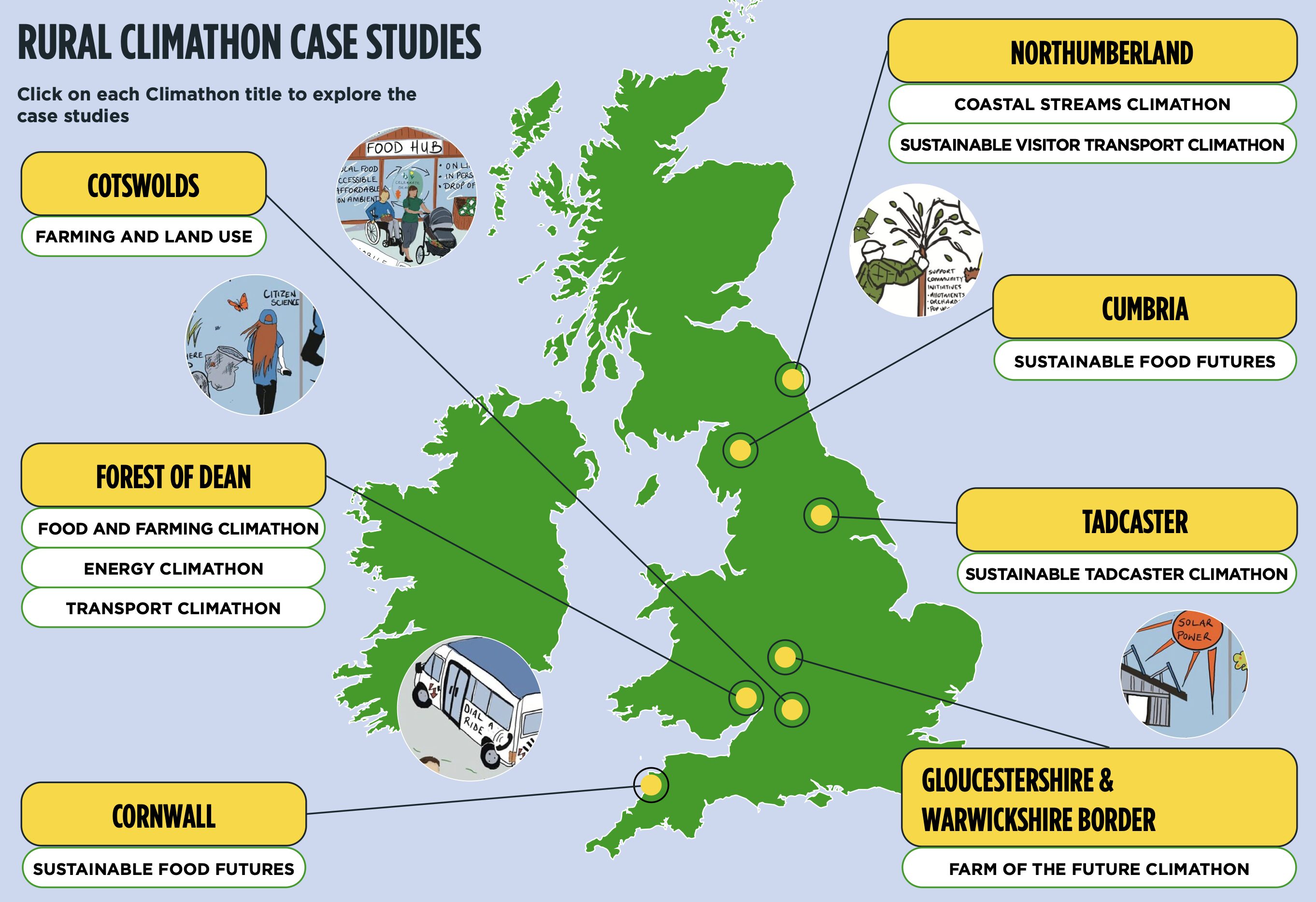
The researchers organised two Climathons in rural areas of England in May 2022, focused on net zero in food and farming. They were introduced to relevant local, stakeholders and partnered with a local climate network, leading to a pragmatic focus in both areas. In Cumbria, the focus was on the Eden Valley, a high-quality agricultural land used for intensive livestock production. In Cornwall, the focus was on the Bude area, due to its significant challenges from sea-level rise. Both areas are impacted by climate change consequences frequently and provide a good basis for analysis.
During the Climathons, research was carried out through non-participation observation by audio recordings and semi-structured interviews with each team to establish benefits and shortcomings of the event. Feedback from participants was vital to the study and allowed for further reflection on its purpose.
After audio transcription and review of feedback forms, thematic analysis was conducted. This identified key themes and trends among responses, including developing the methodology, engaging farmers, enjoyment of experiential components, and tension with the Climathon methodology.
Findings
Events and Participants
The design of the Climathon events was in collaboration with local partners to facilitate inclusion among a range of stakeholders, including farmers and community members. The events were one-day with in-person participation; the Eden Valley event was held on a local farm and the Bude event in a hotel function room.
The ‘informed’ component of deliberation states that arguments should be supported by appropriate and reasonably accurate factual claims. This was reflected in the Climathons through a webinar the day prior to the event, involving evidence-based presentations and local expert opinion. The webinar assisted in creating the evidence used for the problem-solving aspect of the Climathon and ‘informed’ component to ensure all participants understood the issue’s foundation.
Consortium Building
Recruitment for participants was through direct invitation coordinated by local partners and advertised in local media. The stakeholders were a wide variety of those concerned with food, farming, and the environment. The initial phase of each Climathon involved understanding local climate networks and developing relationships with local stakeholders. The events therefore fostered deeper engagement with local climate organisations and networks.
Alignment with Local Initiatives
Specific and unique objectives were emphasised in the events’ design, with communication with local stakeholder partners to avoid duplication. This assisting in increasing the types of data available and insights generated from participants relating to ongoing projects and funding. Local authority strategy was not factored in when creating this project, due to time constraint.
Streamlined Structure
The Climathon structure was streamlined to shorten the event to one working day, rather than the typical 24-hour timeline for many hackathons. The shortened events felt quick to many participants and potentially limited the balanced deliberation component, as arguments faced time pressure on both sides. One debate was also cut short. This structure created a rationalistic theme to the events, logically prioritising some views others.
Collaborative Culture
An aspect of deliberation is participants’ interactions with one another. The removal of the competition element of Climathons in this case assisted in creating a more open dialogue and equitable communication from all participants. Additionally, feedback from participants was presented to peers rather than the whole event, increasing listening and constructive feedback for all involved.
Conclusion
This study is one of the first analysing the suitability of the Climathon methodology. The results were that Climathons are successful in creating a valuable space for discussion on contentious topics, serving to enhance local networks and partnerships. However, not all aspects were successful. The time pressure of the hosted events was snot conducive to the ‘balanced’ component of deliberation and instead promoted accommodation. The action-led approach to Climathons could compliment the use of other deliberative processes, but require strong attention to agenda-setting, event structure, group dynamics, and follow-up.
The main benefits for participants included networking and deep engagement with the issues presented. The outputs of the Climathons assisted in structuring legitimate, inclusive recommendations for action from decisionmakers. The deliberative potential of Climathons can be increased through some of the adaptations suggested in this paper, to increase their participatory benefits and success of outputs. Co-designing events with local stakeholders, alignment with existing initiatives, and pathways through mapping are some suggestions for successfully using the Climathon methodology.
Transformational Adaptation Themes in MACC Hub
Active Engagement
Lasting change depends on genuine collaboration with communities. This MACC Hub pillar is about working together over time, recognising that emotions and values shape how people see risk, and building a shared vision for the future of each place.
Systems Thinking
This pillar is about looking at the bigger picture – how different sectors, places, and people are connected – and making sure actions in one area don’t cause problems in another. It means working across boundaries, creating benefits for people and nature, and being fair about who carries the costs.
Citation
Simmonds, P., Maye, D., Ingram, J., Gardner, A. & Raseta, S. (2025) Deliberative approaches to the climate crisis: Adapting Climathons for rural communities. Area, 57, e12994. Available from: **https://doi.org/10.1111/area.12994** Link to Creative Commons license
Further resources

Rural Climathon Toolkit
Comments
There is no contentYou must be logged in to reply.