
Climate change adaptation laws and policies: A review of trends, gaps and opportunities in 35 countries

This article is an abridged version of the original text, which can be downloaded from the right-hand column. Please access the original text for more detail, research purposes, references, or to quote text.
Summary
This policy report, published by the Grantham Research Institute on Climate Change and the Environment, outlines an overview of the climate adaptation strategies of 35 selected countries. Global trends and key developments are analysed over time and the report concludes with recommendations and actionable guidance, connecting their findings to the broader debate on adaptation at the international and local levels.
Climate change impacts are intensifying, yet adaptation efforts are not keeping pace with the scale and urgency of emerging risks. This report aims to expand the knowledge base on adaptation-relevant laws and policies. It identifies and analyses 902 of these laws and policies over time across 35 countries representing diverse regions, socioeconomic contexts and levels of exposure to climate risks. The analysis shows that the pace of policymaking on adaptation has accelerated in recent years: 75% of adaptation-relevant laws and policies have been adopted since the Paris Agreement in 2015, and 46% since 2020.
Introduction
Climate change impacts are increasing in frequency and severity, but there is a lack of comparative analysis or global adaptation policies. This report aims to understand the trends and priorities among key actors in climate change adaptation, and analyse their similarities and differences to create more comprehensive strategies towards global adaptation.
Though some aspects of the green transition have been heavily researched and compared among states, such as energy pricing and carbon usage, adaptation laws and policies have not been addressed in the same way. Previous academic research centres mitigation, whereas this report addresses this gap through examining how the definitions and practice of adaptation, disaster risk management, and resilience vary among 35 specific countries.
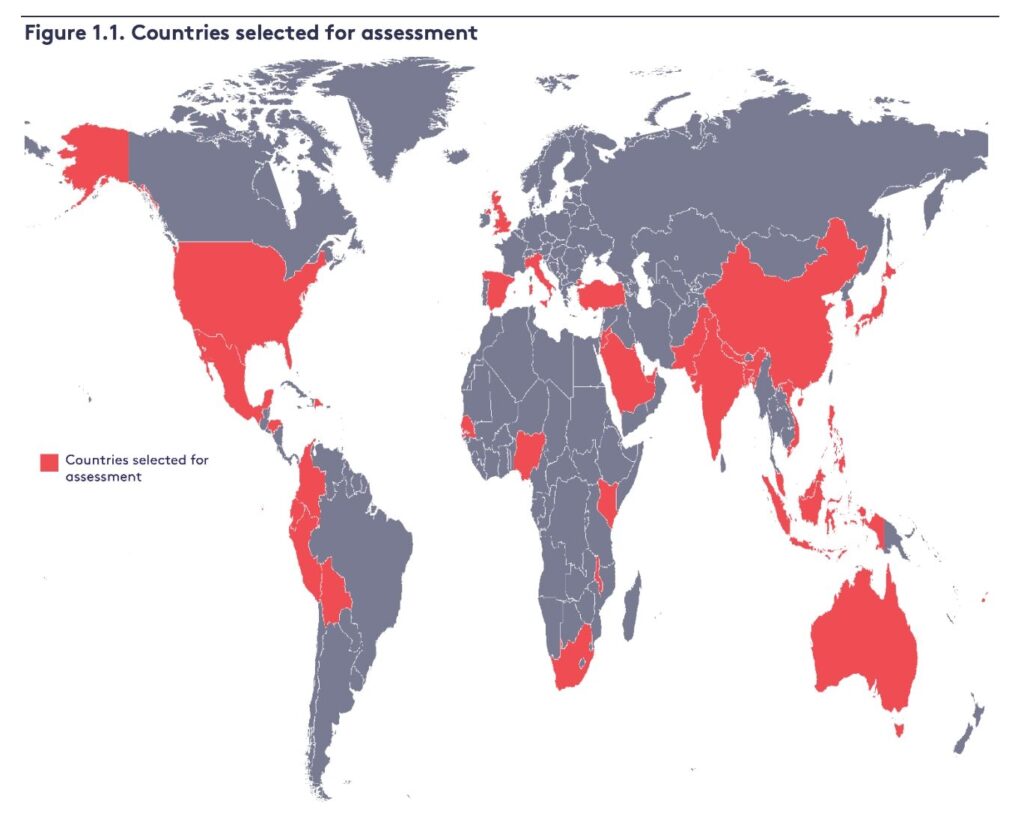
Methods
The areas analysed within this report were selected to represent diversity among the following factors: adaptation governance across geographical regions, income groups, vulnerability to physical climate impacts, exposure to different types of climate hazards and disasters, negotiating groups in the UNFCCC process, and federal or unitary political systems.
The countries covered by the assessment are: Australia, Bangladesh, Barbados, Bolivia, China, Colombia, the Dominican Republic, Ecuador, Fiji, Honduras, India, Indonesia, Italy, Japan, Jordan, Kenya, Kuwait, Malawi, Malaysia, Mexico, Nepal, Nigeria, Pakistan, Peru, the Philippines, Saudi Arabia, Senegal, South Africa, South Korea, Spain, Turkey, the United Arab Emirates, the United Kingdom, the United States and Vietnam.
This report primarily uses policy and comparative analyses to complete its findings, complementing existing initiatives and previous research seeking to understand progress on adaptation actions across state and non-state actors. The laws and policies in the dataset were identified by the research team, which reviewed each document for its relevance to adaptation, disaster risk management or resilience.
The themes of the documents selected for comparative analysis include: adaptation, disaster risk management (DRM), disaster risk reduction (DRR), resilience, laws, and policies. Different levels of emphasis on adaptation were made relevant by the documents.
The main objective is to understand the status of domestic adaptation governance and policy, rather than reporting under the UNFCCC (United Nations Framework Convention on Climate Change) and the Paris Agreement. It is also limited to legislation and policy introduced by national legislatures and executive bodies.
Key Trends and Findings
All 902 national laws and policies identified across the 35 countries in this study were introduced between 1982 and 2025 and display substantial diversity in the extent to which they refer to adaptation. Below are some key trends identified among the countries reviewed:
- Growth and diversification of national adaptation-relevant laws and policies:
- There is a rapid growth in adaptation-relevant laws and policies since 2015.
- A significant number of laws and policies were introduced in 2016 and 2021.
- An increasing number of domestic laws and policies occur over many adaptation themes, particularly ecosystem, biodiversity, agriculture, infrastructure, and poverty alleviation.
- Legal and policy frameworks for adaptation
- There is good progress in establishing legal frameworks for national adaptation planning and risk assessment.
- There are gaps in compliance, regular review, and progress reporting.
- Adaptation has become increasingly assessed in climate change laws and policies.
- 18 of the 35 countries enacted climate framework laws more frequently after the adoption of the Paris Agreement (2015).
- Evolution of domestic adaptation finance-related laws and policies
- There was a graduate shift over time from planning that requires pricing adaptation priorities, integration into public financial management, and systems to track expenses.
- Three categories of policy objectives are emphasised: the central role of public finance, the need for governance to centre finance, and the importance of international climate finance.
- Disaster risk management (DRM) approaches and integration with climate adaptation
- Since 2015, there has been a shift away from solely responsive (DRM) and towards emphasising prevention, preparedness, response, and recovery.
- Most DRM laws and policies establish overarching frameworks, and 20% focus on specific hazards.
- Many DRM laws and policies do not meaningfully integrate climate adaptation, reflecting institutional obstacles.
- Development planning as a vehicle for climate adaptation
- There are 78 development plans identified across 30 countries that incorporate a level of adaptation. 26 plans include adaptation at a significant level, all among 13 Global South countries.
- One third of assessed plans link adaptation to improvements in social wellbeing, identifying this as a future priority.
Recommendations and Conclusion
Based on the analysis, three main policy recommendations for global legislators and policymakers are provided:
- Foster a whole-of-government approach to adaptation and systematically invest in institutional coordination mechanisms, both horizontally and vertically. Actions can include establishing legally-binding requirements for adaptation planning and enacting climate framework laws.
- Institutionalise adaptation within public financial management and fiscal policy frameworks. This can include costing and prioritisation of adaptation investments and increasing fiscal policies that recognise adaptation as an investment in resilience.
- Increase policy coherence and integration of adaptation across disaster risk management and development policy domains. This can include embedding climate risk and vulnerability into disaster risk planning and developing multi-hazard approaches into laws and policies.
The report concludes that taking these actions will allow for greater understanding and representation of adaptation strategies globally, establishing frameworks for selecting and advancing institutional priorities.
Citation
Chan T, Mehryar S, Podestà M and Beswick A (2026) Climate change adaptation laws and policies: a review of trends, gaps and opportunities in 35 countries. London: Grantham Research Institute on Climate Change and the Environment, London School of Economics and Political Science.
Licensed under CC BY-NC 4.0. Commercial permissions requests should be directed to gri@lse.ac.uk.
Transformational Adaptation Principles
Active Engagement
Lasting change depends on genuine collaboration with communities. This pillar is about working together over time, recognising that emotions and values shape how people see risk, and building a shared vision for the future of each place.
Systems Thinking
This pillar is about looking at the bigger picture – how different sectors, places, and people are connected – and making sure actions in one area don’t cause problems in another. It means working across boundaries, creating benefits for people and nature, and being fair about who carries the costs.
Comments
There is no contentYou must be logged in to reply.