
Adapting to climate change: Progress in Scotland



This article is a summary of the original text, which can be downloaded from the right-hand column. Please access the original text for more detail, research purposes, full references, or to quote text. It has been reproduced under Climate Change Committee copyright 2023.
Summary
This report provides the Climate Change Committee’s (CCC) independent assessment of progress made under the second Scottish Climate Change Adaptation Programme (SCCAP2), which covered the period from 2019 to 2024. The CCC’s overarching finding is that while Scotland has a strong strategic framework and clear ambition for climate adaptation, these are not yet being matched by sufficient evidence of delivery. An “implementation gap” exists between stated goals and tangible action on the ground. Despite some signs of progress, actions are not happening at the required scale or pace, and the monitoring of progress remains a key weakness. These findings are intended to inform the development of the third Scottish Climate Change Adaptation Programme (SCCAP3), which is published by the Scottish Government in September 2024 (See ‘Featured Resources’ section).
Key Messages
The key messages as outlined by the Climate Change Committee regarding Scotland’s progress are as follows:
- Good progress has been made in developing a policy framework for adaptation. The Scottish Government has put in place many of the necessary components for an effective response, including a statutory duty on public bodies to act on climate change.
- A significant gap between policy and implementation is opening up. Despite the strong framework, there is little evidence that the scale of adaptation on the ground has increased, and progress has been too slow in most sectors.
- Monitoring of adaptation progress is a key weakness. The current approach to monitoring is insufficient and must be urgently improved to track whether actions are genuinely reducing climate risk.

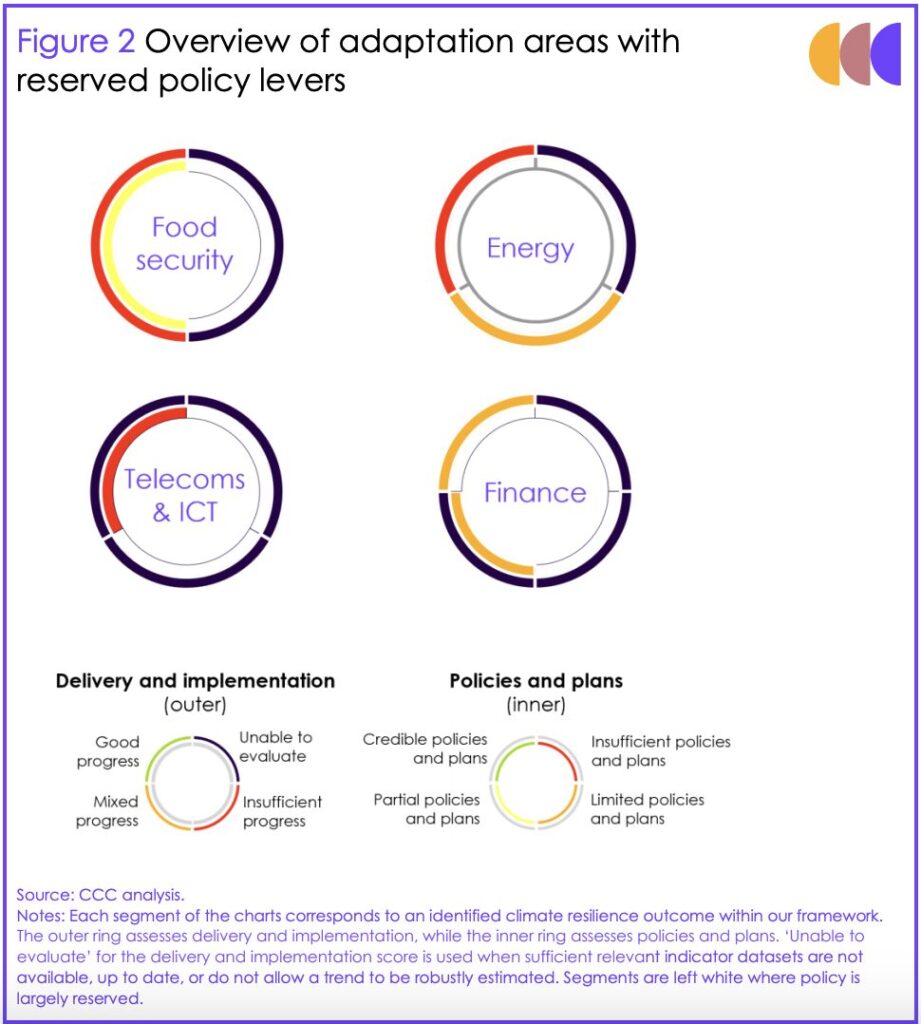
Figure 1 & 2 from the CCC report, visually summarising the assessment of progress across all thematic areas. Figure 1 shows areas formally covered in the adaptation programme, while the Figure 2 shows areas less covered. The prevalence of orange, red, and grey illustrates the limited progress and significant data gaps in delivery.
Framing and Methodology
The CCC’s assessment framework evaluates progress against key outcomes needed to build climate resilience. The assessment considers progress across thirteen thematic areas, scoring each on two distinct fronts:
- Policies and Plans: Assessing whether critical policy and planning milestones are in place and are sufficiently ambitious.
- Delivery and Implementation: Using indicator-based evidence to assess whether tangible actions are reducing climate vulnerability and exposure on the ground.
A primary challenge noted throughout the report is that the absence of a comprehensive, indicator-based monitoring framework for SCCAP2 makes it difficult to fully assess the effectiveness of actions.
Outcomes and Impacts
The implementation gap is leading to mixed results and growing risks across Scotland. The report’s findings can be illustrated by examining three representative areas:
1. Good ambition, mixed reality: Flood Risk Management (Chapter 9: Towns and Cities)
Scotland has strong legislation for flood risk management, but on-the-ground delivery shows a mixed and worrying reality.
The Reality: Despite the good plans, delivery has fallen short. Of the 14,600 properties projected to be protected in the first cycle of schemes (2016-2021), only about 40% (5,900 properties) are covered by schemes that are either completed or under construction. Furthermore, the condition of many existing flood defence assets is unknown because data inputs are inconsistent, and there is limited evidence on the delivery of nature-based solutions like upstream land management. To address these gaps, the report notes that the Scottish Government has committed to developing a new national flood strategy.
The Plans: The Flood Risk Management (Scotland) Act 2009 provides a world-leading, plan-led approach to managing flood risk. This is implemented through six-year planning cycles, with the second cycle of Flood Risk Management Plans (FRMP) published in 2021 to cover the period up to 2028.
2. A key natural asset at risk: Nature and Peatlands (Chapter 2: Nature)
Scotland’s natural environment, particularly its vast peatlands which are crucial for both biodiversity and carbon storage, remains under significant threat due to a failure in meeting restoration targets.
The Impact: This significant shortfall in restoration means that Scotland’s degraded peatlands continue to harm biodiversity and act as a carbon source, directly undermining both climate adaptation and Net Zero goals. To address this, the report recommends that the Scottish Government set an ambitious, long-term, and funded peatland restoration target beyond 2030.
The Problem: The report finds that peatland restoration rates remain below annual target levels. In 2022-23, an estimated 7,000 hectares were restored, which is only around a third of the committed annual rate of 20,000 hectares.
3. A persistent blind spot: Health and Wellbeing (Chapter 11: Health)
Despite the clear and growing risks from climate change to human health, the report finds insufficient progress in this area, with policies and plans rated as limited.
The Impact: Even without official monitoring, the consequences are becoming apparent. Climate change is projected to increase annual heat-related deaths in Scotland to between 70 and 285 by 2050. There is also evidence of a real underlying increase in climate-sensitive illnesses, with confirmed laboratory cases of Lyme disease in Scotland, increasing by nearly 81% between 2020 and 2021. To address this, the Scottish Government recommends that Public Health Scotland develop a dedicated adverse weather and health plan as part of its new strategic approach to climate change.
The Problem: The report highlights a critical lack of systematic data collection on the health impacts of extreme weather in Scotland. Key metrics on mortality and morbidity from heatwaves and flooding are not regularly recorded. Furthermore, there is no long-term plan for managing these risks, although Public Health Scotland (PHS) has recently published a strategic approach that acknowledges this gap.
Lessons Learned
The assessment of Scotland’s adaptation progress offers several critical lessons for the next phase of climate action:
- Ambition and governance are not enough without action: Scotland’s experience shows that even a strong policy framework is insufficient if it is not translated into widespread, tangible delivery. Overcoming the “implementation gap” is the primary challenge.
- Effective adaptation requires robust monitoring: The report highlights that without a clear, indicator-based monitoring framework, it is impossible to know if adaptation actions are working or to hold public bodies to account.
- Statutory duties on public bodies need to be actively driven and resourced: Simply placing a duty on public bodies to act is not enough. They require clear guidance, support, and access to data to fulfil their obligations effectively.
Recommendations
The CCC concludes that the next Scottish Climate Change Adaptation Programme (SCCAP3) must be used to drive a step-change in delivery and implementation. The report’s recommendations focus on:
Accelerating action in key sectors: Prioritise closing policy gaps and accelerating delivery in critical areas such as the natural environment (especially peatlands), the built environment (overheating and flood risk), infrastructure, and health.
Developing a world-class monitoring framework: The Scottish Government must urgently develop and implement a comprehensive, indicator-based framework to track progress and identify where further action is needed.
Driving delivery through public bodies: Provide stronger guidance, support, and direction to Scotland’s public bodies to ensure they are fulfilling their statutory duties on adaptation.
Embedding adaptation into wider policy: Use all policy levers, including the forthcoming Land Use Framework and new Agriculture Bill, to embed climate resilience across the economy and society.
Citation
Climate Change Committee (2023) Adapting to climate change: Progress in Scotland. Available at: https://www.theccc.org.uk/publication/adapting-to-climate-change-progress-in-scotland/ (Accessed: 12 August 2025).
Scottish Government (2024) Climate change: Scottish National Adaptation Plan 2024-2029. Edinburgh: Scottish Government. Available at: https://www.gov.scot/publications/scottish-national-adaptation-plan-2024-2029-2/documents/ (Accessed: 14 August 2025)
Further resources


CCC: England’s approach to climate adaptation is ‘not working’


Adapting to climate change: Progress in England

Adapting to climate change: Progress in Wales

Comments
There is no contentYou must be logged in to reply.