
Prepared and overheating: 2022 heatwaves exposed a nation at risk

This article is a summary version of the original text, which can be downloaded from the right-hand column. Please access the original text for more detail, research purposes, full references, or to quote text.
Summary
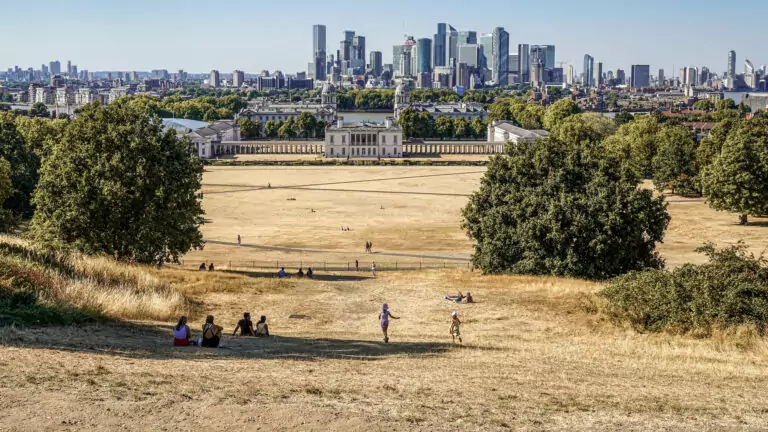
The summer of 2022 was England’s trial by fire. As temperatures soared past 40°C for the first time in UK history, a national emergency was declared. The London Fire Brigade faced its busiest day since World War II, transport networks buckled, and 2,985 excess deaths were recorded. This was not a freak event, but a stark warning of the future. Now, a landmark report from the Grantham Research Institute on Climate Change and the Environment warns that England remains dangerously ill-prepared for the escalating threat of extreme heat.
Summer heatwaves in context
The UK experienced five heatwave periods during summer 2022 with record-breaking temperatures of over 40°C in England. The Government declared a national emergency following the Met Office’s first ever issuance of a red ‘extreme heat’ warning. Forty-six temperature monitoring stations across England breached previous temperature records. The heatwaves were associated with a total of 2,985 excess deaths in England.
The temperatures seen during the July heatwave were made 10 times more likely due to anthropogenic climate change, according to the World Weather Attribution group. Research by the Met Office suggests that summers which see temperatures above 40°C somewhere in the UK occur about every 100–300 years at present, but without efforts to mitigate greenhouse gas emissions, this could become as frequent as once every 3.5 years by 2100.
Summer 2022 was not an anomaly: it was part of a warming trend in which extreme heat events are projected to become more likely as the climate continues to change. 2022 was the warmest year on record for the UK, 2023 was the second warmest, and the 10 hottest years the country has experienced have all occurred since 2002.
Decision-makers and practitioners working on the frontline of the heatwave response in England consider the country to be ill-prepared for future extreme heat events and that the 2022 heatwaves stretched the health response to its limit; these include emergency responders, medical professionals, third sector and local government actors. It is therefore vital to learn from the experience of the summer 2022 heatwaves and ensure that England and the wider UK are better prepared for extreme heat in the future.
The impacts of increasing heat risk in the UK
Under a high greenhouse gas emissions scenario and without adaptation, heat-related deaths in the UK are estimated to increase by almost 166% in the 2030s (4,266 total deaths per year), 580% in the 2050s (10,889 deaths per year) and 1,244% in the 2070s (21,545 deaths per year), compared with a 2007–2018 baseline.
Aside from causing additional deaths, heatwaves exacerbate existing health, social and economic inequalities, and there are differences in regional heat vulnerabilities and exposure. Over half of UK homes are at risk of overheating, which is projected to increase to 90% of homes under a 2°C global warming scenario. Buildings in the UK have been designed to protect from the cold rather than the heat, and few domestic buildings are appropriately equipped with measures such as external shading. High temperatures cause damage and disruption to infrastructure including railways and roads, leading to delayed and cancelled journeys, road closures and congestion, causing further heat exposure risks to travellers. Heat affects the natural environment in a range of ways. Heat stress affects animals, plants, trees and ecosystems while drought conditions, exacerbated by heatwaves, intensify water scarcity and dry out the natural environment, further increasing the risk of grass and wildfires. Heat affects the provision of essential ecosystem services including water, impacting food production, disrupting supply chains and affecting food prices.
Policies and governance for heat
While the most effective way to minimise the longer-term impacts of extreme heat is through cuts in greenhouse gas emissions, the severity and frequency of heatwave periods around the world, including in the UK, will continue to grow in the short term even once global emissions reach net zero. Therefore, management of heat risk and adaptation will be required to protect the population from more frequent and longer heatwaves of greater magnitude.
- There is a governance gap when it comes to managing the risk of extreme heat in England, with no clear coordination between policies, or across government departments at local, regional or national scales.
- Existing policies related to managing extreme heat are fragmented and do not adequately address the severity or urgency of this risk, as highlighted by the Climate Change Committee’s Adaptation Progress Reports to Parliament.
- The Third National Adaptation Programme recognises the risks to human health from extreme heat, but fails to offer actions of sufficient scale and urgency to significantly improve heat preparedness.
- Measures to tackle overheating such as greater use of air conditioning, as well as efforts to reduce emissions through improvements to home insulation without improving ventilation and cooling, could lead to increased energy consumption and further contribute to climate change.
- Limited progress has been made to address the risks of heat, drought and wildfires in the natural environment – and to harness the opportunities of nature-based solutions.
- The severity of extreme heat risks and impacts in the UK are often underestimated by the population.
A blueprint for a heat-resilient nation
To address the UK’s weak and scattered heat risk policy, a National Heat Risk Strategy should be developed that works alongside a strengthened National Adaptation Programme, to ensure a step change in progress on addressing heat risk at all geographical levels. The strategy would require a clear vision with a set of short- and long-term actions and priorities, co-produced with a wide range of decision-makers from across the public, private and third sectors and prioritising those must vulnerable to extreme heat. This would be a long term strategy, integrating and aligning with other policy priorities relating to climate adaptation and mitigation as well broader considerations for issues relating to inequality, justice and fairness.
The research into the 2022 heatwave response and its shortcomings points to eight core priorities for the National Heat Risk Strategy, detailed in the figure below.
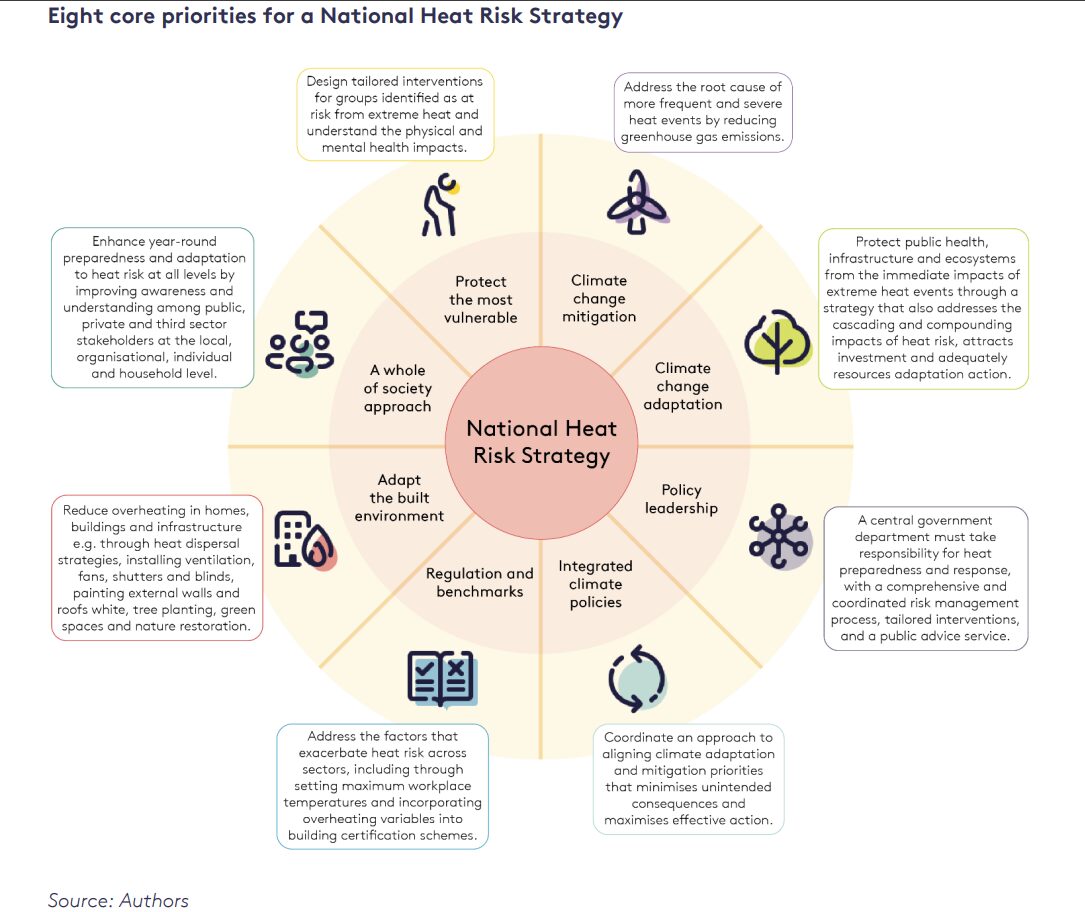
The “Turning up the heat” report is not just a diagnosis of the problem but also a clear call to action. Its central recommendation is the urgent development of a comprehensive National Heat Risk Strategy, coordinated by a single government department and co-produced with frontline services and communities. The authors outline eight core priorities for this strategy:
- Protect the most vulnerable through tailored interventions and support.
- Pursue ambitious climate change mitigation to address the root cause of warming.
- Implement widespread climate change adaptation to protect against unavoidable impacts.
- Establish clear policy leadership by assigning a central government department with responsibility for heat risk.
- Develop integrated climate policies that align adaptation and mitigation for maximum benefit.
- Introduce robust regulation and benchmarks, including setting maximum workplace temperatures.
- Adapt the built environment through mass retrofitting, green infrastructure, and nature-based cooling solutions.
- Foster a whole-of-society approach to build year-round awareness and preparedness.
The heatwaves of 2022 were a glimpse into the UK’s climate future. The evidence is clear that the current reactive and fragmented approach is dangerously insufficient, costing not only money but preventable deaths. As the report concludes, becoming a heat-resilient nation requires a fundamental “step change in leadership and commitment to act at all levels.” The question is no longer if the UK will act, but whether it will act in time.
Citation
Howarth C, McLoughlin N, Armstrong A, Murtagh E, Mehryar S, Beswick A, Ward B, Ravishankar S, & Stuart-Watt A. (2024). Turning up the heat: Learning from the summer 2022 heatwaves in England to inform UK policy on extreme heat. Grantham Research Institute on Climate Change and the Environment, London School of Economics and Political Science.
Further resources


Including Adaptation in your Green Plan – adaptation plan template and guidance for the NHS
Developing adaptation capability of the NHS in England – a pilot project


Heatwaves, hospitals and health system resilience in England: a qualitative assessment of frontline perspectives from the hot summer of 2019

Adapting to Climate Change: The Alice Holt ‘Living Laboratory’ Forest
Comments
There is no contentYou must be logged in to reply.