
Into the Red: Counting the cost of climate inaction

This article uses extracts and summaries of the original text, which can be downloaded from the right-hand column. Please access the original text for more detail, case examples, for full references, or to quote text.
Summary
Climate change is already costing Scotland billions of pounds a year. Unchecked climate change could drive these costs to 5-20% of GDP, around £11bn – £45bn a year, by 2050. Spending even a few billion a year by 2030 on a just transition is a bargain compared to the economic and social damage climate change will do without further action. On impacts like flooding, wildfires, droughts and rising temperatures there are good predictions about what the future will hold for Scotland and which areas will be most affected. This means Scotland can act to minimise these impacts, at the same time as the country rapidly reduces its emissions. Scotland could be saving over £30bn a year by the 2050s with collective action to tackle climate change.

Projected costs of climate inaction in Scotland (see page 3 of report)
The current main costs to Scotland come from damage and disruption caused by flooding, damage to agricultural crops and the impact of stronger storms, as well as deaths and ill health from higher temperatures. Acting now to reduce emissions is much cheaper than waiting until things are worse. The significant and steeply rising level of economic damage already inflicted on Scotland (let alone the much larger cost likely in the future) is a big incentive to urgently reduce our emissions at home, make our country and society more resilient and play a strong part in helping the world to achieve real reductions in its emissions.
Introduction
From floods and droughts to wildfires, disruption to transport and supply chains, and the spread of new diseases, climate change is already imposing major costs on society here in Scotland. Much is often made of the cost of the transition to net zero. For Scotland estimates for this transition range from £1.2 to 5bn a year by 2030. Set against this are the billions in costs that climate change is already imposing on Scotland, and the rapid increase in these costs of doing nothing.
Spending money to reduce climate emissions can save money and improve lives. For example, the National Audit Office estimates that for every £1 spent on protecting communities from flooding, around £9 in property damages and wider impacts can be avoided. And insulating people’s homes has the quadruple benefit of reducing climate emissions, saving the householder money, creating jobs in the energy sector and making the property healthier to live in. Scotland is already spending money on adaptation to climate change, for instance the £400m the Scottish Government has allocated to increase the resilience of the railways. The Climate Emergency Response Group estimate that £1.8bn is needed for climate resilience work between now and 2030.
Costs of inaction for Scotland and the UK
“Climate change poses profound risks to our economy. The costs to the Scottish economy, resulting from climate change, are no longer hypothetical. The Climate Change Committee have estimated the impacts of climate change already cost the Scottish economy billions of pounds per year.”
Scottish National Adaptation Plan, September 2024
For Scotland estimates of current and future costs vary widely, partly because of which impacts are included in each study.
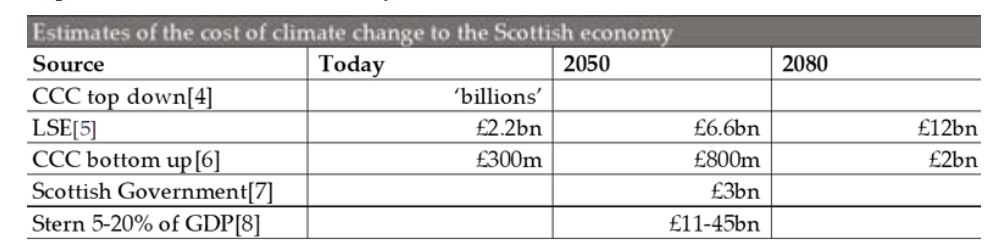
Estimates of the cost of climate change to the Scottish economy (see page 7 of report)
- Climate change is already costing Scotland billions of pounds a year. Unchecked climate change could drive these costs to 5-20% of GDP, around £11bn-£45bn a year by 2050.
- Climate costs for Scotland could be rising by £400m a year; the more conservative estimates from the Scottish Government suggest the cost of climate impacts is increasing by £40m a year.
- Unchecked climate change impacts for the Glasgow city region would be £400m a year by 2050, with the burden falling disproportionately on disadvantaged and vulnerable groups.
- Highland region’s GDP could be reduced by around 1.5% a year by the 2050s, and up to 3.3% a year by the 2080s.
Regional costs within Scotland
Work in 2018 for Climate Ready Clyde estimated that the cost of unchecked climate change impacts for the six-local-authority Glasgow city region would be £400m a year by 2050, about 1% of Gross Value Added. They also concluded that the burden of these costs would fall disproportionately on disadvantaged and vulnerable groups. Looking at four large one-off climate-related weather events between 2012 and 2017 they found a total cost to the city region of £44.5m. Highland Adapts have published a series of reports on the impacts of climate change on the Highlands. They summarise their findings thus:
- Climate change will have potentially significant negative impacts on the Highland region equivalent to around -1.5% Gross Domestic Product (GDP) a year by the 2050s, rising to up to -3.3% a year by the 2080s.
- Impacts from flooding (coastal, river, and surface water) are estimated to increase from around £11 million per year currently to £20 million per year by the middle of the century and double that by the end of the century.
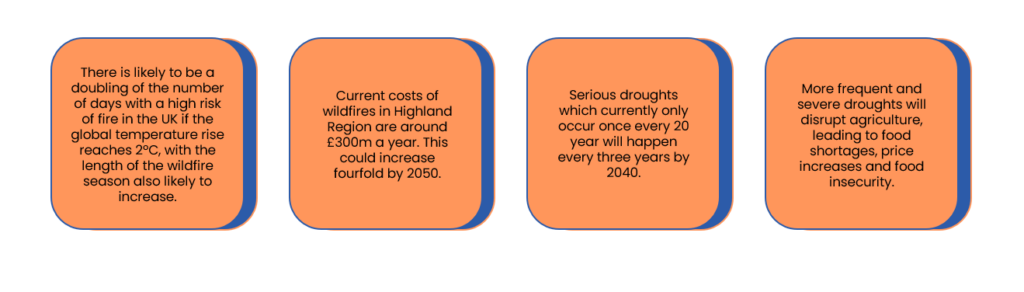
- The potential economic costs of wildfires were estimated using data from current wildfires, economic costs of wildfire suppression, and non-market impacts from the release of greenhouse gas emissions and air pollutants. Current costs are estimated to be approximately £300 million a year, driven by the high societal cost of carbon emissions. This could increase fourfold by mid-century.
- Risks to the energy sector include high negative impacts on energy generation, energy distribution, and on the delivery of net zero plans for the energy sector. The analysis also found some economic benefits for Highland residents from a reduced need for wintertime heating.
- Risks to salmon production from rising sea temperature and ocean acidification will increase by the 2050s. Risks to whisky production from extreme events and climate conditions will also increase significantly over this time period.
- For the forestry and timber sector, costs from high winds; drought, pests, and disease; and wildfires were estimated to rise significantly between 2030 and 2090
Costs by Impact area
In Scotland climate change is already affecting people’s health and wellbeing, damaging the economy, disrupting travel, threatening nature and making farming and fishing more difficult. The main impacts already being experienced are from increasing flooding and water scarcity, stronger and more frequent storms, more wildfires and higher temperatures. There are often many different estimates of costs in a particular area and sometimes there is no overall estimate of current and future costs. The following sections summarise what is known about costs for a range of impacts.
FLOODING
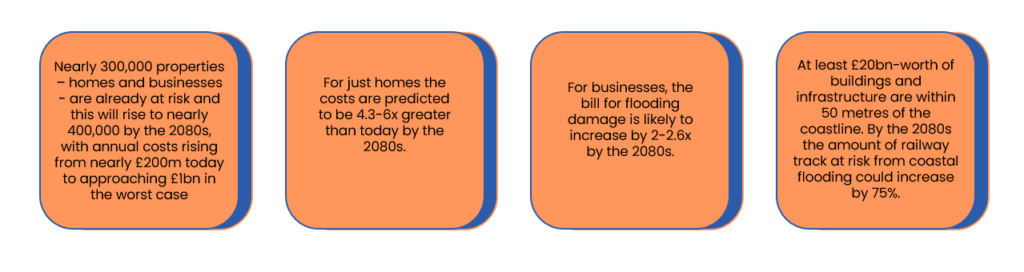
Increased flooding is probably the most noticeable manifestation of climate in Scotland. Climate change is making flooding more frequent and more severe, and areas previously unlikely to flood are now at risk. Heavier and more intense rainfall and rising sea levels make surface water, river and coastal floods more likely. Floods threaten people’s homes and businesses, energy and transport infrastructure, and cultural heritage and nature sites.
HUMAN HEALTH AND CHANGING TEMPERATURES
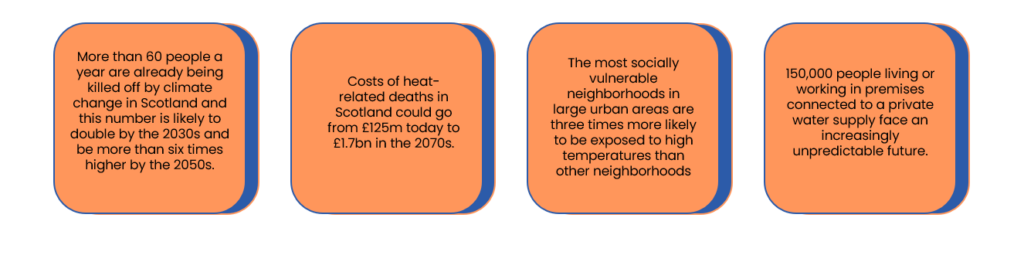
People are already dying in Scotland because of elevated temperatures brought on by climate change and the number could be six times higher in 30 years’ time, with a combined annual cost from death and illness in the billions by the 2070s, with an additional £500 million a year being spent to deal with people who are made ill by high temperatures. The most socially disadvantaged groups are generally at most risk, with the young, the old and the ill particularly vulnerable. Worrying about climate change takes a serious toll on people’s mental health, especially among young people, leading to feelings of uncertainty and being overwhelmed and emotions including anger, despair and grief.
DROUGHTS AND FIRES
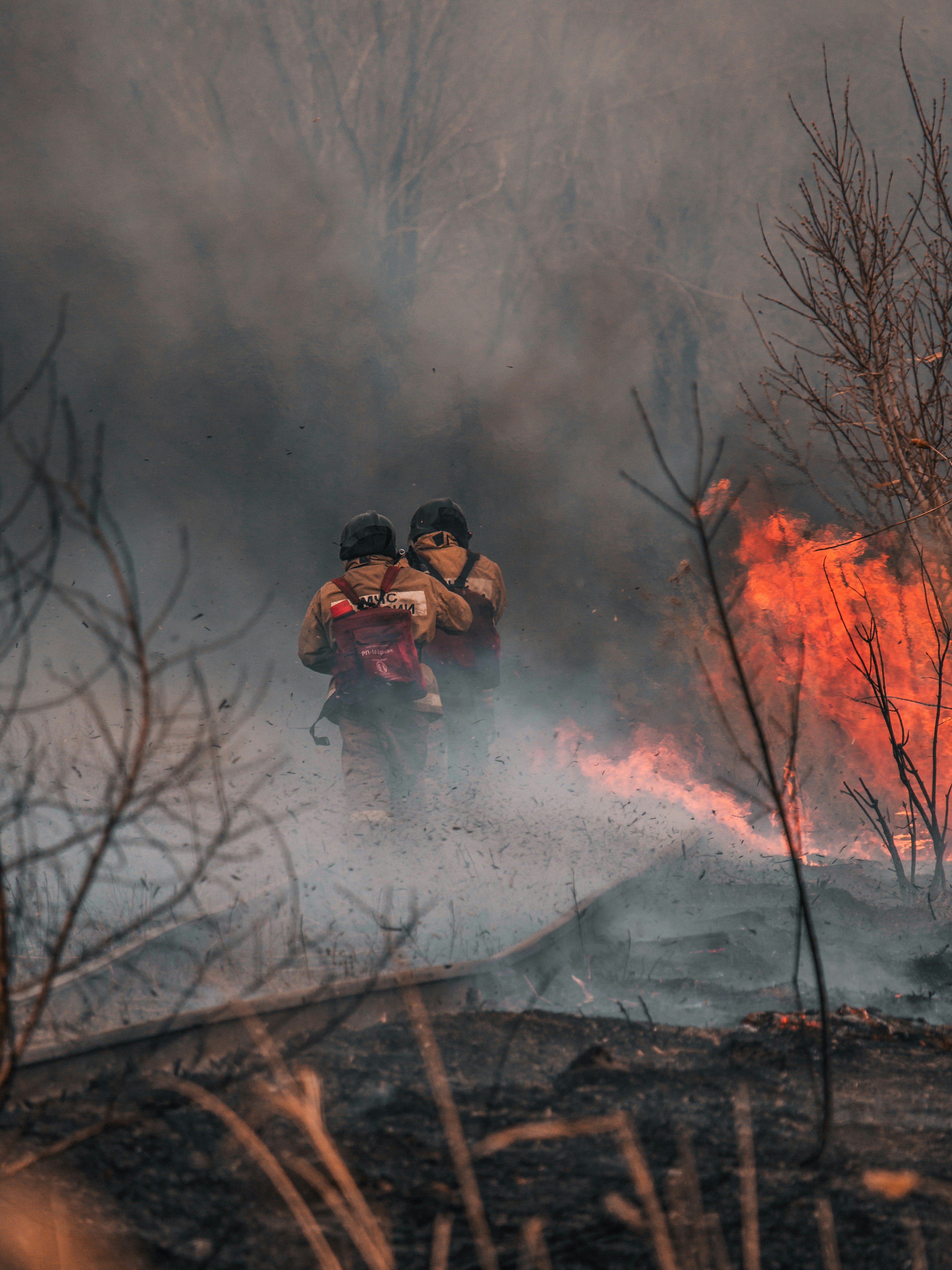
Drought and wildfires are both increasing in frequency and severity. Even in water-rich Scotland, water scarcity is becoming a problem for householders and businesses in some areas and a lack of snow is a growing problem for the skiing industry.
STORMS
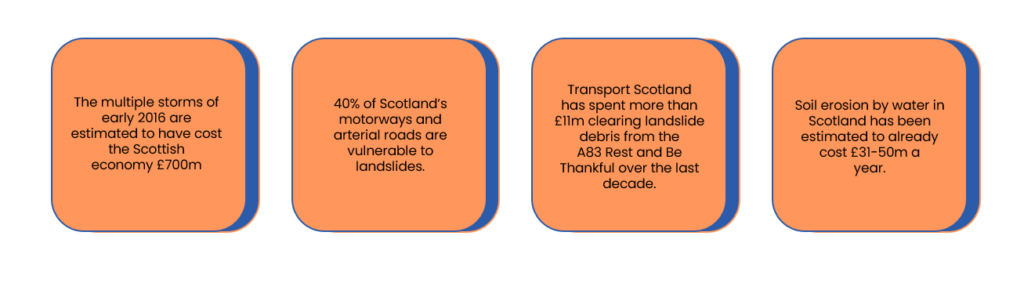
Although the scale of future change is hard to predict, the increasing frequency and strength of storms is leading to property damage, disruption to transport and energy networks, and soil erosion, as well as contributing to flooding. The economic costs of major storms can be in the hundreds of millions of pounds and the cost of landslips can be in the millions. In the case of the 2020 Stonehaven derailment climate change contributed to three deaths, with fines and compensation in the millions of pounds.
Plant and animal diseases, and non-native species
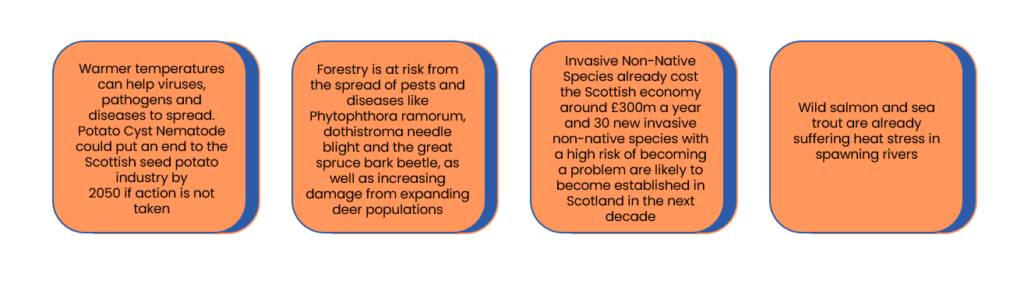
Warmer temperatures can help plant and animal viruses, pathogens and diseases to spread. Some of these, including Potato Cyst Nematode could be devastating for agriculture or forestry in Scotland. The future for fisheries and aquaculture is uncertain. The changing climate also encourages non-native species to become established in Scotland, competing with native wildlife and causing problems for farmers and foresters, at a cost of £300m a year.
Recommendations
The paper recommends that the Scottish Government, in collaboration with the UK Government where needed, should:
- Ensure a minimum proportion of existing and future public expenditure is net carbon positive – expand public sector duty to assess carbon impacts in all public budgets
- Create a Climate Wealth Fund – invest a share of e.g. windfall tax, carbon taxes, climate related fines, energy revenues etc. in a future focused pot to fund short- and long-term climate action
- Establish an independent Climate Oversight Body – to scrutinise policies and drive climate action, like the Future Generations Commissioner for Wales
- Mandate Climate Expertise on Boards – require boards in industry and public bodies to learn about climate change and assign a responsible board member for climate action
- Invest in Climate Education & Skills Training – embed climate learning across all education sectors and make organisational climate literacy a requirement for public contracts
- Publish and Deliver the Climate Change Plan – with an integrated and fully funded implementation plan for all sectors
- Fund ongoing studies on climate impacts – including on measures to reduce or eliminate these impacts
Suggested Citation
Dixon, Richard. 2025. Into the Red: Counting the Cost of Climate Inaction. Report for the Royal Scottish Geographical Society. May 2025. Royal Scottish Geographical Society. PDF download. https://www.rsgs.org/Handlers/Download.ashx?IDMF=33768e2f-d8a1-42b3-bb16-23ae8032270d
Further resources


Adapting to climate change: Progress in Scotland


Comments
There is no contentYou must be logged in to reply.